Water is an essential resource for almost every business and industrial operation. From manufacturing and food processing to hotels, hospitals, restaurants, pharmaceuticals, and commercial facilities, the quality and availability of water can directly affect daily operations.
When water contains high levels of dissolved salts, hardness, chemicals, suspended particles, or other impurities, a Reverse Osmosis (RO) plant can provide an effective solution for producing purified water.
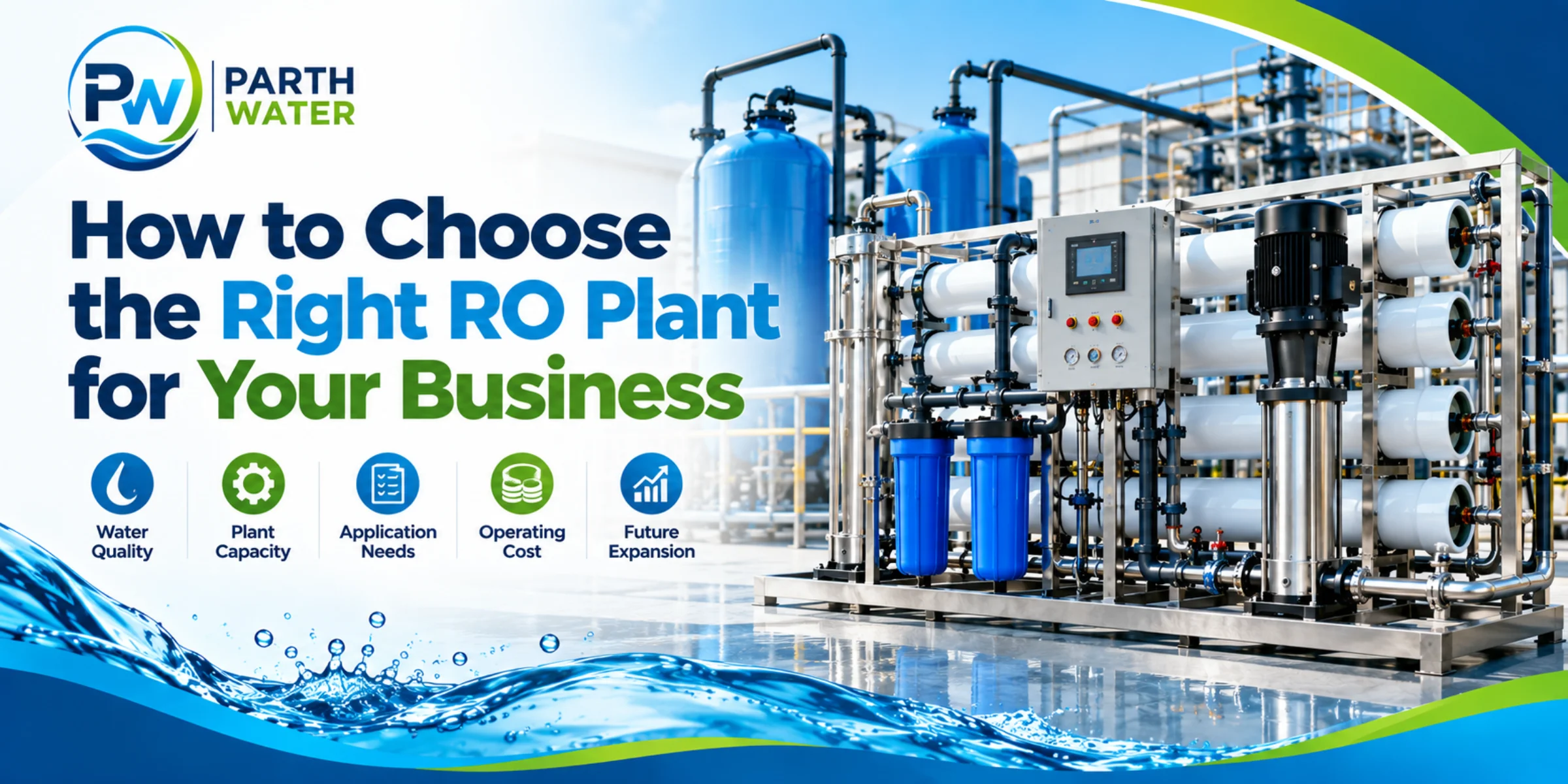
However, choosing the right RO plant is not simply about selecting a system with the highest capacity or the lowest price. The ideal system depends on several factors, including raw-water quality, daily water consumption, required water quality, application, recovery rate, operating cost, available space, and future expansion.
In this guide, we explain the key factors businesses should consider when choosing the right RO plant for their business.
What Is an RO Plant?
A Reverse Osmosis plant is a water purification system that uses a semi-permeable membrane to remove dissolved salts, minerals, and other contaminants from water.
During the RO process, pressure is applied to feed water and pushed through specialized membranes. The membrane allows water molecules to pass through while rejecting a significant portion of dissolved impurities.
The process produces two primary streams:
- Permeate: Purified water produced by the RO system
- Reject: Concentrated water containing the rejected impurities
An RO plant can be used as a standalone water purification system or integrated with other treatment technologies depending on the quality of the incoming water and the final application.
Why Choosing the Right RO Plant Matters
Every business has different water requirements. A small restaurant and a large manufacturing facility cannot necessarily use the same RO system.
Choosing an incorrectly sized or poorly designed system can result in:
- Insufficient treated-water production
- Higher electricity consumption
- Frequent membrane replacement
- Poor water quality
- Increased maintenance costs
- Excessive water wastage
- Reduced equipment life
- Production interruptions
On the other hand, a properly designed industrial RO plant can provide consistent treated water while helping businesses manage their water resources efficiently.
Therefore, the selection process should begin with an assessment of your actual water requirements rather than simply comparing equipment prices.
1. Understand Your Raw-Water Quality
The first and most important step when selecting an RO plant is to understand the quality of your incoming water.
Water may come from sources such as:
- Borewell
- Municipal supply
- Surface water
- Tanker supply
- Industrial process water
- Treated wastewater
Each source can have different water characteristics.
A professional water analysis should ideally examine parameters such as:
- Total Dissolved Solids (TDS)
- pH
- Hardness
- Turbidity
- Iron
- Chloride
- Sulphate
- Silica
- Alkalinity
- Microbiological parameters
The test results help determine the appropriate RO configuration and pretreatment requirements.
For example, water with high hardness may require softening or antiscalant treatment before it enters the RO membranes.
2. Determine Your Daily Water Requirement
The next step is calculating how much purified water your business actually needs.
Consider:
- Daily water consumption
- Peak water demand
- Operating hours
- Production requirements
- Storage capacity
- Future expansion
For example, if a facility requires 20,000 litres of purified water every day, the RO plant should be selected based on the required production rate and operating schedule.
It is also important to distinguish between daily demand and hourly demand.
A business operating 8 hours a day may need a different RO plant capacity than a facility operating 24 hours a day.
An experienced RO plant manufacturer can help calculate the appropriate plant capacity based on your actual consumption pattern.
3. Identify the Application of Treated Water
Not all purified water needs to meet the same quality standards.
The required water quality depends on how the treated water will be used.
Drinking Water
For drinking-water applications, the treatment system may require additional purification and disinfection depending on the raw-water quality and applicable requirements.
Manufacturing
Manufacturing industries may require treated water for production processes, equipment cleaning, cooling, or other applications.
Boiler Feed Water
Boiler systems often require carefully controlled water quality to reduce scaling and other operational problems. Additional treatment may be required after RO depending on the boiler and water-quality requirements.
Food and Beverage Industry
Food-processing applications may have specific water-quality requirements, making proper pretreatment and purification particularly important.
Pharmaceutical Applications
Pharmaceutical manufacturing can require highly controlled water quality and may use RO alongside additional purification technologies.
Understanding the end use allows the RO system to be designed according to the required treated-water quality.
4. Select the Appropriate RO Plant Capacity
RO plants are available in different capacities to meet different requirements.
The capacity should be selected based on actual demand rather than simply choosing the largest available system.
An undersized RO plant may struggle to meet demand, while an oversized plant can result in unnecessary capital expenditure and inefficient operation.
Capacity planning should consider:
- Current water demand
- Peak demand
- Operating hours
- Storage tanks
- Future expansion
- Required water recovery
For businesses with changing demand, it may be useful to discuss modular or expandable RO plant configurations with the manufacturer.
5. Consider the Recovery Rate
RO recovery refers to the percentage of feed water converted into useful permeate.
For example, if an RO system receives 10,000 litres of feed water and produces 7,000 litres of permeate, the recovery is approximately 70%.
The remaining water becomes reject or concentrate.
Higher recovery can reduce feed-water consumption, but achieving it depends on the raw-water characteristics, membrane configuration, scaling potential, pretreatment, and system design.
Therefore, recovery should be optimized rather than simply maximized.
Businesses should also have a plan for managing or reusing RO reject water where practical.
6. Evaluate Pretreatment Requirements
Pretreatment is one of the most important components of an RO system.
RO membranes can be affected by:
- Suspended solids
- Hardness
- Chlorine
- Iron
- Organic matter
- Microorganisms
- Scaling compounds
Depending on the water analysis, an RO plant may require pretreatment such as:
- Multimedia filtration
- Sand filtration
- Activated carbon filtration
- Water softening
- Micron filtration
- Antiscalant dosing
- Iron removal
- Chemical dosing
A properly designed pretreatment system helps protect RO membranes and can contribute to consistent plant performance.
7. Check the Quality and Type of RO Membranes
RO membranes are among the most important components of the system.
The appropriate membrane selection depends on factors such as:
- Feed-water TDS
- Water temperature
- Operating pressure
- Required permeate quality
- Recovery
- Feed-water chemistry
Businesses should avoid selecting membranes based solely on price.
Membrane quality can affect water production, rejection performance, energy consumption, and replacement frequency.
The RO system should also be designed to allow convenient membrane inspection and replacement.
8. Consider Energy Consumption
Energy consumption is an important consideration, particularly for businesses operating RO plants continuously.
High-pressure pumps are typically one of the major energy-consuming components of an RO system.
Energy requirements can depend on:
- Feed-water TDS
- Required operating pressure
- Plant capacity
- Recovery
- Pump efficiency
- Membrane performance
- System design
When comparing RO plants, businesses should consider not only the initial purchase price but also the expected operating cost over the system’s lifetime.
A slightly higher initial investment in efficient equipment may be worthwhile if it contributes to lower long-term operating expenses.
9. Consider Automation and Monitoring
Modern RO plants can incorporate automation and monitoring systems that help operators manage plant performance.
Depending on the application, an RO plant may monitor:
- Feed pressure
- High pressure
- Permeate flow
- Reject flow
- TDS or conductivity
- Tank levels
- Pump operation
- System alarms
For large industrial facilities, automation can help simplify operation and identify performance changes.
Smaller commercial systems may require less sophisticated controls.
The appropriate level of automation should therefore be based on plant size, application, operating requirements, and available technical staff.
10. Evaluate Space and Installation Requirements
Before purchasing an RO plant, determine where the system will be installed.
Consider the space required for:
- RO skid
- Pretreatment equipment
- Storage tanks
- Pumps
- Electrical control panels
- Chemical dosing equipment
- Pipelines
- Maintenance access
Industrial RO systems can require significant installation space, especially when multiple pretreatment stages and storage tanks are included.
Adequate access should also be provided for membrane replacement, filter servicing, pump maintenance, and inspection.
11. Calculate the Total Cost of Ownership
The purchase price is only one part of the total cost of an RO plant.
Businesses should evaluate:
Capital Cost
This includes the initial cost of the RO system, pretreatment equipment, pumps, control panels, tanks, piping, and installation.
Electricity Cost
High-pressure pumps and other equipment consume electricity during operation.
Consumables
These may include:
- Cartridge filters
- Chemicals
- Antiscalants
- Cleaning chemicals
- Other consumables
Membrane Replacement
RO membranes have a finite operating life and may need replacement depending on operating conditions and maintenance.
Maintenance
Regular inspection and servicing are essential for maintaining plant performance.
Considering the complete life-cycle cost of an RO plant provides a better basis for comparing different systems.
12. Plan for RO Reject Water
RO purification produces reject water containing concentrated dissolved impurities.
Businesses should consider how this stream will be managed before installing the system.
Depending on the application and local requirements, potential approaches may include suitable reuse applications or additional treatment.
For facilities with strict wastewater-management requirements, advanced systems such as Zero Liquid Discharge (ZLD) may also be considered where technically and economically appropriate.
Reject-water management should therefore be included in the overall water-treatment strategy.
13. Choose an Experienced RO Plant Manufacturer
The quality of engineering and after-sales support can have a major impact on RO plant performance.
When evaluating an RO plant manufacturer, consider:
- Experience in your industry
- Customized system design capability
- Quality of components
- Engineering expertise
- Installation support
- Maintenance services
- Availability of spare parts
- Technical support
- Warranty terms
- System documentation
A manufacturer should ideally evaluate your raw-water analysis and application before recommending a system.
Be cautious about selecting a plant based only on the lowest quotation.
Industrial RO Plant or Commercial RO Plant?
The right type of RO plant depends largely on your water requirement.
Commercial RO Plant
A commercial RO plant is generally suitable for applications such as:
- Restaurants
- Hotels
- Offices
- Schools
- Small institutions
- Cafeterias
- Commercial establishments
These systems are generally designed for moderate water requirements.
Industrial RO Plant
An industrial RO plant is generally used for:
- Manufacturing facilities
- Pharmaceutical industries
- Chemical industries
- Food-processing plants
- Textile industries
- Power-related applications
- Large institutions
- Process industries
Industrial systems typically offer higher capacity and greater customization.
Common Mistakes to Avoid When Buying an RO Plant
Businesses can avoid several common mistakes by taking a systematic approach.
Choosing Based Only on Price
The cheapest system may not provide the required performance or long-term value.
Ignoring Raw-Water Testing
Without proper water analysis, the pretreatment and membrane configuration may be inappropriate.
Choosing Excessive Capacity
An oversized plant can increase unnecessary capital and operating costs.
Ignoring Reject-Water Management
RO reject should be considered during system planning.
Neglecting Maintenance
Even a high-quality RO plant can experience performance problems without proper maintenance.
Not Considering Future Requirements
Businesses should consider potential expansion when designing the plant.
Conclusion
Choosing the right RO plant for your business requires more than comparing capacities and prices. The right system should be designed around your raw-water quality, daily water requirement, application, required treated-water quality, recovery objectives, available space, operating costs, and future expansion plans.
A properly designed RO plant can provide consistent purified water, support industrial and commercial operations, protect downstream equipment, and improve overall water-management efficiency.
Before making a purchase, conduct a detailed water analysis, calculate your actual water demand, determine the required treatment quality, and discuss your requirements with an experienced RO plant manufacturer.
For businesses looking for reliable water-treatment solutions, a customized approach is often more effective than selecting a standard system without evaluating the specific water and operational requirements.