Reverse Osmosis (RO) technology has become an important part of modern water purification. From offices, hotels, restaurants, hospitals, and educational institutions to large manufacturing facilities, industries and commercial establishments use RO systems to improve water quality and reduce dissolved impurities.
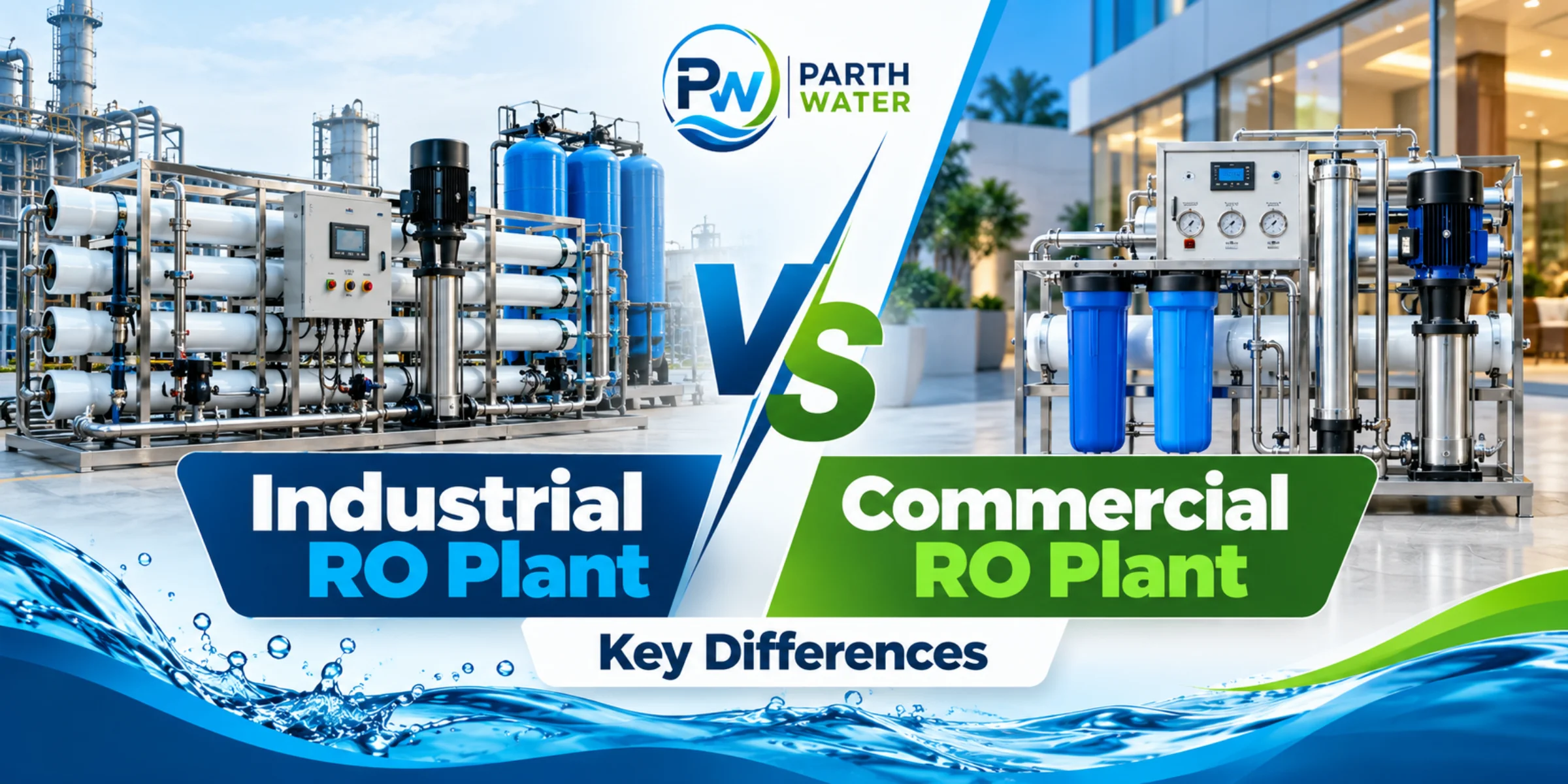
However, industrial RO plants and commercial RO plants are not the same. Although both systems use the Reverse Osmosis process, they differ significantly in terms of capacity, design, membrane configuration, automation, operating requirements, applications, and overall cost.
Choosing the right RO system is important because an undersized plant may not meet your water requirements, while an unnecessarily large system can increase capital and operating costs.
In this article, we will explain the key differences between an industrial RO plant and a commercial RO plant, their applications, benefits, and the factors businesses should consider when selecting the right solution.
What Is an RO Plant?
An RO plant, or Reverse Osmosis plant, is a water purification system that uses a semi-permeable membrane to remove dissolved salts, minerals, contaminants, and other impurities from water.
During the RO process, water is passed through a membrane under pressure. The membrane allows water molecules to pass through while rejecting a significant portion of dissolved substances.
The process generally produces two streams:
- Permeate: Purified water that passes through the RO membrane
- Reject/Concentrate: Water containing the rejected dissolved contaminants
Depending on the source-water quality and required output, an RO system can be combined with pretreatment technologies such as sand filtration, activated carbon filtration, micron filtration, water softening, or other treatment processes.
What Is an Industrial RO Plant?
An Industrial RO Plant is a high-capacity water purification system designed for manufacturing facilities and other applications requiring large volumes of treated water.
Industrial RO plants are generally designed for continuous operation and can be customized according to raw-water quality, production requirements, required permeate quality, and water recovery targets.
Industrial RO systems are commonly used in:
- Manufacturing industries
- Pharmaceutical industries
- Chemical industries
- Food and beverage industries
- Textile industries
- Power plants
- Hotels and large institutions
- Automobile industries
- Dairy industries
- Electronics manufacturing
- Process industries
The capacity of an industrial RO plant can vary considerably depending on the application. Large systems may be designed to produce thousands or more litres of purified water per hour.
What Is a Commercial RO Plant?
A Commercial RO Plant is generally designed for businesses and establishments that require purified water in moderate quantities.
Commercial RO systems are commonly installed in:
- Restaurants
- Hotels
- Offices
- Schools and colleges
- Hospitals
- Shopping centres
- Cafeterias
- Small manufacturing units
- Residential complexes
- Food-service establishments
These systems are typically smaller and simpler than industrial RO plants while still providing effective purification for their intended applications.
Industrial RO Plant vs Commercial RO Plant
Although both systems use Reverse Osmosis technology, there are several important differences between them.
| Feature | Industrial RO Plant | Commercial RO Plant |
|---|---|---|
| Primary Use | Industrial and high-volume applications | Commercial and moderate-volume applications |
| Capacity | High | Low to medium |
| Operation | Often continuous | Usually intermittent or scheduled |
| Design | Highly customized | Standardized or semi-customized |
| Automation | Higher level of automation | Basic to moderate automation |
| Pretreatment | More extensive | Relatively simpler |
| Number of Membranes | Multiple membranes | Usually fewer membranes |
| Installation | Requires dedicated space | Requires comparatively less space |
| Maintenance | More complex | Relatively simple |
| Initial Investment | Higher | Lower |
| Water Demand | High-volume requirements | Moderate-volume requirements |
Let’s examine these differences in more detail.
1. Difference in Water Treatment Capacity
One of the biggest differences between industrial and commercial RO plants is capacity.
Industrial facilities may require a large and continuous supply of treated water. Their RO systems are therefore designed to process substantial quantities of water.
For example, a manufacturing facility may require treated water throughout its production process, while a restaurant may only require purified water for drinking, cooking, or food preparation.
Commercial RO systems are therefore generally suitable for lower water requirements, whereas industrial RO systems are designed for significantly higher demand.
Before selecting an RO plant, businesses should calculate their daily water consumption and peak demand.
2. Difference in System Design
Industrial RO plants are generally engineered according to the specific requirements of the facility.
The design may take into account:
- Raw-water quality
- Feed-water TDS
- Required permeate quality
- Daily water demand
- Recovery percentage
- Operating pressure
- Temperature
- Pretreatment requirements
- Water-reuse objectives
Commercial RO systems are often based on standard configurations and require less complex engineering.
This makes commercial systems easier to install for many smaller applications.
3. Difference in Pretreatment
Pretreatment is extremely important for RO membrane performance.
Industrial RO systems often require multiple stages of pretreatment because the source water may contain significant amounts of suspended solids, hardness, iron, organic matter, or other contaminants.
Depending on water quality, pretreatment may include:
Raw Water → Multimedia Filter → Activated Carbon Filter → Softener/Antiscalant → Micron Filter → RO
Commercial RO systems may use a simpler pretreatment arrangement depending on the source water and application.
Proper pretreatment helps protect RO membranes from fouling, scaling, and premature performance loss.
4. Difference in Membrane Configuration
Industrial RO plants typically use multiple membranes arranged in a carefully engineered configuration to achieve the required production capacity and recovery.
The number and type of membranes depend on the system’s design capacity and feed-water characteristics.
Commercial RO systems generally use fewer membranes and smaller components.
The membrane configuration therefore directly influences the plant’s water production capacity, footprint, energy consumption, and operating requirements.
5. Difference in Automation
Industrial RO plants often incorporate advanced automation and monitoring systems.
Depending on the plant design, operators may monitor parameters such as:
- Feed pressure
- RO pressure
- Permeate flow
- Reject flow
- Conductivity/TDS
- pH
- Tank levels
- Pump status
- Membrane performance
Automation can help improve process consistency and make it easier to identify operational problems.
Commercial systems may use simpler controls because their operational requirements are generally less complex.
6. Difference in Applications
The applications of industrial and commercial RO plants also differ.
Industrial RO Applications
Industrial RO systems can be used for:
- Process water
- Boiler feed water
- Cooling applications
- Manufacturing processes
- Pharmaceutical water treatment
- Food processing
- Chemical processing
- Textile production
- Power-generation applications
Commercial RO Applications
Commercial RO systems can be used for:
- Drinking water
- Restaurant operations
- Hotel water purification
- Office drinking-water systems
- School and institutional applications
- Cafeterias
- Small-scale food businesses
The right system depends on the quality and quantity of water required for the application.
7. Difference in Installation Requirements
Industrial RO plants generally require more installation space because they include larger pumps, pressure vessels, membrane assemblies, pretreatment equipment, storage tanks, control panels, and associated piping.
Commercial RO plants typically have a smaller footprint and can be installed in comparatively compact areas.
For industrial applications, plant layout is an important part of the design process.
Adequate space should be provided for:
- Equipment installation
- Pipeline connections
- Electrical systems
- Chemical dosing
- Membrane replacement
- Maintenance activities
- Operator access
8. Difference in Energy Consumption
Industrial RO plants generally consume more energy because they process larger volumes of water and may operate at higher pressures.
However, energy consumption depends on several factors, including:
- Feed-water TDS
- Operating pressure
- Plant capacity
- Membrane type
- Recovery rate
- Pump efficiency
- Pretreatment quality
Commercial RO systems usually have lower overall energy requirements because of their smaller capacity.
Energy efficiency should therefore be considered when selecting an RO plant, particularly for facilities operating continuously.
9. Difference in Maintenance
Maintenance requirements can also vary considerably.
Industrial RO plants require regular monitoring and maintenance of:
- RO membranes
- High-pressure pumps
- Pretreatment filters
- Cartridge filters
- Dosing systems
- Valves
- Instrumentation
- Electrical controls
- Storage tanks and pipelines
Commercial systems generally have fewer components, making routine maintenance relatively straightforward.
Regardless of the system size, regular maintenance is important for maintaining water quality and extending equipment life.
10. Difference in Initial Investment
Industrial RO plants generally require a higher initial investment because they involve larger equipment, greater capacity, more complex pretreatment, advanced controls, and customized engineering.
Commercial RO plants typically require a lower investment.
However, businesses should not select an RO plant based solely on purchase price.
The total cost of ownership may include:
- Electricity
- Membrane replacement
- Filter replacement
- Chemicals
- Maintenance
- Labour
- Water consumption
- Reject-water management
A properly designed system can provide better long-term value by matching the plant capacity with actual water requirements.
How to Choose Between an Industrial and Commercial RO Plant?
The right choice depends primarily on your water requirement and application.
Consider the following factors before selecting a system.
1. Determine Daily Water Requirement
Calculate how much purified water your facility requires per day and during peak operating periods.
2. Test the Raw Water
A detailed water analysis can identify:
- TDS
- Hardness
- pH
- Iron
- Turbidity
- Chloride
- Sulphate
- Silica
- Microbiological parameters
This information helps determine the appropriate pretreatment and RO configuration.
3. Identify the End Use
Drinking water, boiler feed water, process water, pharmaceutical applications, and food processing may have different quality requirements.
4. Consider Future Expansion
If your business is expected to expand, the RO system should be planned accordingly.
5. Evaluate Water Recovery
Businesses should also consider how much feed water will be converted into useful permeate and how the reject stream will be managed.
6. Work With an Experienced RO Plant Manufacturer
An experienced RO plant manufacturer can evaluate the water source, treatment requirements, plant capacity, and application before recommending a suitable configuration.
Can Industrial RO Plants Be Customized?
Yes. Customization is one of the major advantages of industrial RO systems.
An industrial RO plant can be designed according to:
- Required production capacity
- Feed-water quality
- Required TDS reduction
- Water recovery targets
- Available space
- Automation requirements
- Water-reuse requirements
- Industry-specific standards
This allows industries to develop a treatment system that fits their specific operational requirements rather than relying on a one-size-fits-all solution.
Importance of RO Plant Maintenance
Whether commercial or industrial, an RO system needs regular maintenance.
Poor maintenance can result in:
- Reduced water production
- Increased TDS in permeate
- Higher energy consumption
- Membrane fouling
- Scaling
- Increased operating costs
- Reduced membrane life
Regular monitoring of pressure, flow, conductivity, and other key parameters can help identify performance changes early.
Pretreatment equipment should also be maintained because effective pretreatment is critical to RO membrane protection.
Industrial RO Plant vs Commercial RO Plant: Which One Is Right for You?
There is no single RO system that is suitable for every business.
A commercial RO plant is generally appropriate where the purified-water requirement is moderate and the application does not require a highly customized, high-capacity system.
An industrial RO plant is designed for facilities that require larger quantities of treated water, continuous operation, customized engineering, and more advanced treatment and monitoring.
The decision should therefore be based on actual water consumption, raw-water quality, required treated-water quality, application, operating conditions, and future requirements.
Conclusion
Understanding the difference between an industrial RO plant and a commercial RO plant is important when planning a water purification system.
While both use Reverse Osmosis technology, industrial systems are generally designed for higher capacity, continuous operation, complex pretreatment, customized engineering, and demanding industrial applications. Commercial RO plants are generally more compact and suitable for businesses and institutions with moderate water requirements.
Before investing in an RO plant, businesses should conduct a detailed water analysis, calculate their actual water demand, identify the intended application, and evaluate long-term operating requirements.
Choosing the right RO water treatment system can help improve water quality, support efficient operations, protect downstream equipment, and contribute to better water-resource management.
For businesses looking for reliable water purification solutions, working with an experienced RO plant manufacturer and water treatment solution provider can help ensure that the system is designed according to the facility’s specific water requirements.